Austria
Austria
The project’s home country: records since 1987, first reproduction in 2007 in Neusiedler See – Seewinkel National Park. Monitoring, research and status reports are ongoing.
About the project in AustriaFind out more about the biology and ecology of Canis aureus.
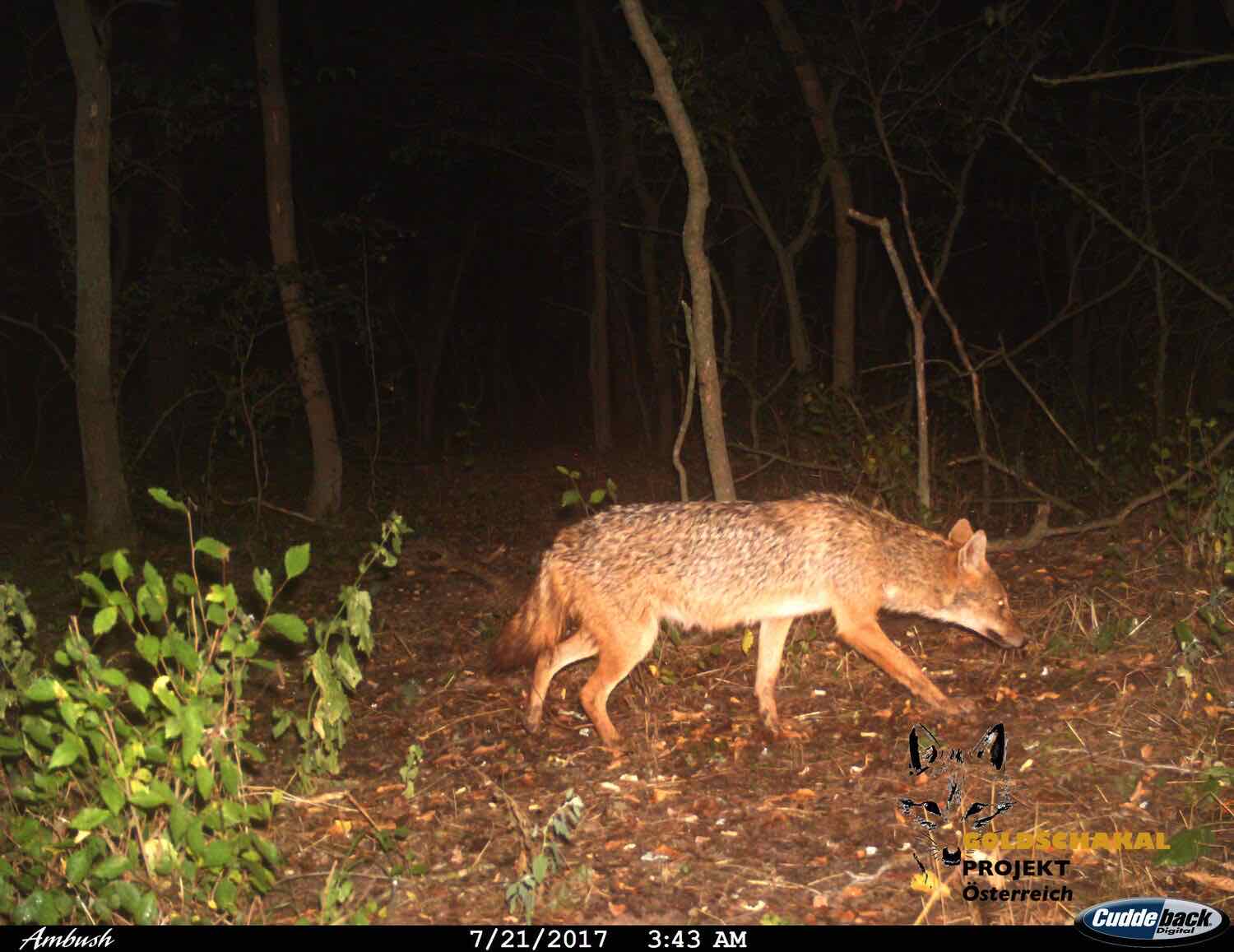
With a shoulder height of 44 – 50 cm, a body weight of up to 15 kg and a body length of around 105 cm, the golden jackal is a medium-sized carnivore of the genus Canis in the family Canidae. Its coat is yellowish-grey (sometimes described as reddish), dark along the back and at the tip of the tail, and golden on the flanks and legs. Its brown facial mask is set off by distinct white markings around the muzzle and on the throat.
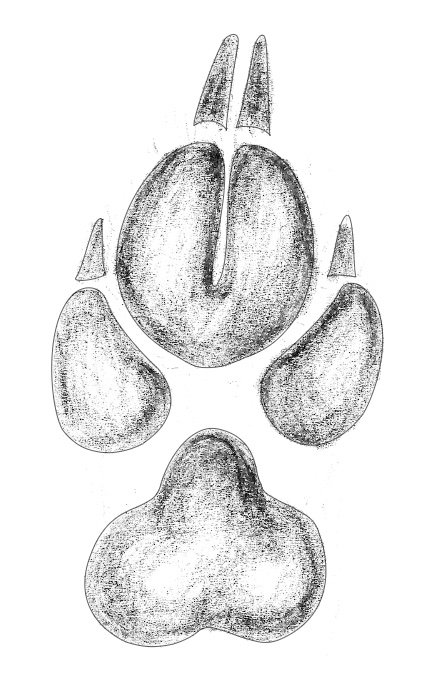
The golden jackal’s footprint resembles that of a large fox, but the central pads are fused at the bottom. This applies to both the front and hind feet.
The golden jackal is a dietary generalist and an opportunist that adapts very well to the season, habitat and available resources. Its main prey are small to medium-sized mammals, but it also eats amphibians, insects, fish, frequently carcasses, plant matter and human-derived food (in some regions slaughter waste). In heavily hunted areas its main food is gut piles left behind by hunters or the carrion of ungulates that were never recovered.
In Europe the mating season falls in January and February. Gestation lasts about 61 – 62 days, and the female usually gives birth to four to five pups (rarely up to twelve). As a rule, one helper stays with the parents to assist in raising the next litter. Mostly crepuscular and nocturnal, the golden jackal lives in a flexible social system in which partners stay together for life, mark their territory together and hunt together.
The golden jackal is flexible in its choice of habitat. It finds good conditions and plenty of food in richly structured farmland as well as in wetlands. Near human settlements, sufficient cover and daytime hiding places play an important role; in protected areas with many undisturbed zones this matters less.
Its natural range extends from North Africa across Asia to central, eastern and southern Europe. According to a genetic study by Koepfli et al. (2015), however, the African and Eurasian golden jackals are two different species. The African golden jackal is therefore more closely related to the wolf (Canis lupus); the proposed distinction is between the “African golden wolf” (Canis lupaster) and the “Eurasian golden jackal” (Canis aureus).
There have been occasional golden jackal records in Austria since 1987; in 2007 the first reproduction was reported in Neusiedler See – Seewinkel National Park. The records to date are compiled for each monitoring year in an up-to-date status report.
Source: Hatlauf, J., Krickl, R. (2025): Der Goldschakal – Lebenskünstler auf leisen Pfoten, Band 1. Aureus, 264 S. (www.aureus.co.at, in German).
The golden jackal is spreading across large parts of Europe. Here you will find records, contacts and further information from various countries.
More and more countries are reporting their first or resident golden jackal records. Do you have a record from one of these countries? Report it or get in touch directly with the organisation listed for that country. How records are documented and assessed is described in our criteria – with recordings of howling.
The project’s home country: records since 1987, first reproduction in 2007 in Neusiedler See – Seewinkel National Park. Monitoring, research and status reports are ongoing.
About the project in AustriaIn Germany, golden jackal occurrences and records are centrally documented and processed by the DBBW, the Federal Documentation and Advisory Centre on Wolves.
dbb-wolf.de – golden jackal (in German)So far only individual animals; no reproduction has yet been documented. The first photographic record came in 2011/12 during lynx monitoring in the north-western Alps, and reports have been increasing since. The species is protected under the Swiss federal hunting law, and monitoring is coordinated by the KORA foundation.
KORA – golden jackalSpreading since the 1980s; the core consists of reproducing populations in the north-east (Friuli Venezia Giulia), from where the species is slowly advancing southwards. Nationally, the golden jackal is strictly protected under the hunting and wildlife protection law (L. 157/92) and may not be hunted; at EU level it is listed in Annex V of the Habitats Directive.
Lapini et al., Natural History SciencesA long-term case in central Europe: the first jackals reached the country more than 70 years ago, the population has become more permanent since the 2000s, and stable family groups have been confirmed in the border area with Italy – the species is considered established and reproducing. Its legal status has changed several times; since around 2014 it has been hunted as a game species while remaining on the list of protected species.
Potočnik, Krofel et al., Mammal ResearchOne of the largest golden jackal populations in central Europe. The first modern record of reproduction dates from 1995; since then the population has grown rapidly and now occupies most of the country, recently with signs of stabilisation. The species is hunted, and the centrally recorded hunting bags are the most important source of trend data.
Bijl & Csányi et al., PLOS ONE 2024Now permanently established. The earliest report dates from 1947 and the first modern record from 1989 in the south-east near the Hungarian border; since then numbers and range have increased markedly across the country. Legally, the species was classified as game with a closed season in 2001 and has been huntable since 2009.
Slamka et al., Canid Biology & ConservationRecords are becoming more frequent and the first reproductions have already occurred: after an early single record in 2006, the first documented breeding was in 2017 near Milovice (Central Bohemia), with a second indication of breeding in 2022 south of Prague. Settlement is therefore at an early stage and still characterised by isolated occurrences; at EU level the species falls under the Habitats Directive.
Strnad et al., Lynx n. s. 2023A summary of sightings in Denmark and an up-to-date distribution map (2015–2018) are provided by Mogens Trolle (Natural History Museum of Denmark, University of Copenhagen).
Sightings in Denmark (in Danish)First record in the principality: on 12 March 2018 a golden jackal walked into a camera trap in Ruggell – only a matter of time after confirmed records in Switzerland, Germany and Austria. Press release from the Office of Environment.
Liechtensteiner Vaterland report (in German)Information on the goudjakhals from the Zoogdiervereniging (Dutch Mammal Society) and from “Wolven in Nederland”, plus numerous news reports since the first record in 2016.
zoogdiervereniging.nl (in Dutch)First record in Finland – a report by the public broadcaster Yle documents the event.
Report on yle.fi (in Finnish)No confirmed records so far – but the protected species could turn up at any time. Please send observations (ideally with a photo) to the Administration de la nature et des forêts: fauna@anf.etat.lu.
Brochure “Der Goldschakal in Luxemburg” (in German)First confirmed record from summer 2020 (made public in February 2021) near Lakselv in the north of the country.
Report on nrk.no (in Norwegian)We are very keen on national and international cooperation – let’s connect our research! Collaboration has achieved a great deal, particularly in the border regions: bilateral projects with Hungary and Slovakia carried out systematic surveys, and international projects enable expert exchange across national borders.
Are you researching golden jackals in your country or interested in working together? Let us know – we would be happy to add your link or logo here.
How well do you know the golden jackal? Three levels – beginner, intermediate and expert – with ten questions each and one correct answer per question.
Start the quizHelp research with your observation – every record counts.
Report a sighting